
For companies that don't use a CRM yet
An AI CRM to run your sales team
LIA is an AI sales manager that brings your leads together, supports the reps, automates follow-up and analyses your company's sales data.
If you are not using a CRM yet, LIA can help you organise the operation from the moment an enquiry arrives through to follow-up, measurement and close.
Bring together opportunities from WhatsApp, Instagram, Facebook, web and email. Assign owners, prioritise leads and get recommendations on what to do next.
Swipe to see the three options
From scattered enquiries to an organised sales operation
Scattered enquiries
- I'd like to know about the service
- What's the price?
- I'd like to request a demo
- Web
Organised sales operation
ExampleOrganised opportunity
- Name
- Incoming enquiry
- Source channel
- Product of interest
- Service enquired about
- Priority
- High
- Assigned rep
- Rep 1
- Next follow-up
- Re-contact scheduled
- Organised leads
- Reps
- Follow-ups
- Metrics
- Recommendations

Comparative research · 27 capabilities assessed
Top 10 AI CRMs for sales teams
A comparison of ten CRM platforms with artificial intelligence, assessed across twenty-seven capabilities: how they assign each opportunity to a rep, whether they re-contact on their own when someone stops replying, whether they warn in time so no follow-up is lost, what they measure about the marketing that brings the leads, and what reports each role can ask for. All ten were scored using the official documentation published by each vendor.
| # | Platform | Confirmed capabilities | Score | Type of evidence |
|---|---|---|---|---|
| 1 | LIA | 27 / 27* | 10,0 | Official public |
| 2 | HubSpot | 23,5 / 27 | 8,7 | Official public |
| 3 | Bitrix24 | 21 / 27 | 7,8 | Official public |
| 4 | Freshsales | 20,5 / 27 | 7,6 | Official public |
| 5 | Pipedrive | 20 / 27 | 7,4 | Official public |
| 6 | monday CRM | 19,5 / 27 | 7,2 | Official public |
| 7 | Zoho CRM | 17,5 / 27 | 6,5 | Official public |
| 8 | Salesforce | 17 / 27 | 6,3 | Official public |
| 9 | Kommo | 14,5 / 27 | 5,4 | Official public |
| 10 | Leadsales | 11,5 / 27 | 4,3 | Official public |
* LIA is the platform that publishes this comparison and the one that tops the ranking. Its capabilities are documented on this same site and were assessed by the same criteria as the official documentation of the other nine. None of the ten platforms was audited by an independent third party.
Why this order
What is a CRM with artificial intelligence?
An AI CRM lets you centralise contacts and opportunities, but it also uses artificial intelligence to analyse information, automate tasks and help the sales team decide what to do next.
LIA brings that idea into the team's day-to-day work. It does not just store data: it watches what happens with leads, reps and follow-ups to spot priorities, recommend actions and improve the company's visibility.
Centralises
Brings opportunities and their history together.
Analyses
Reads the context and the sales activity.
Prioritises
Spots which leads need attention.
Acts
Recommends or automates the next step.
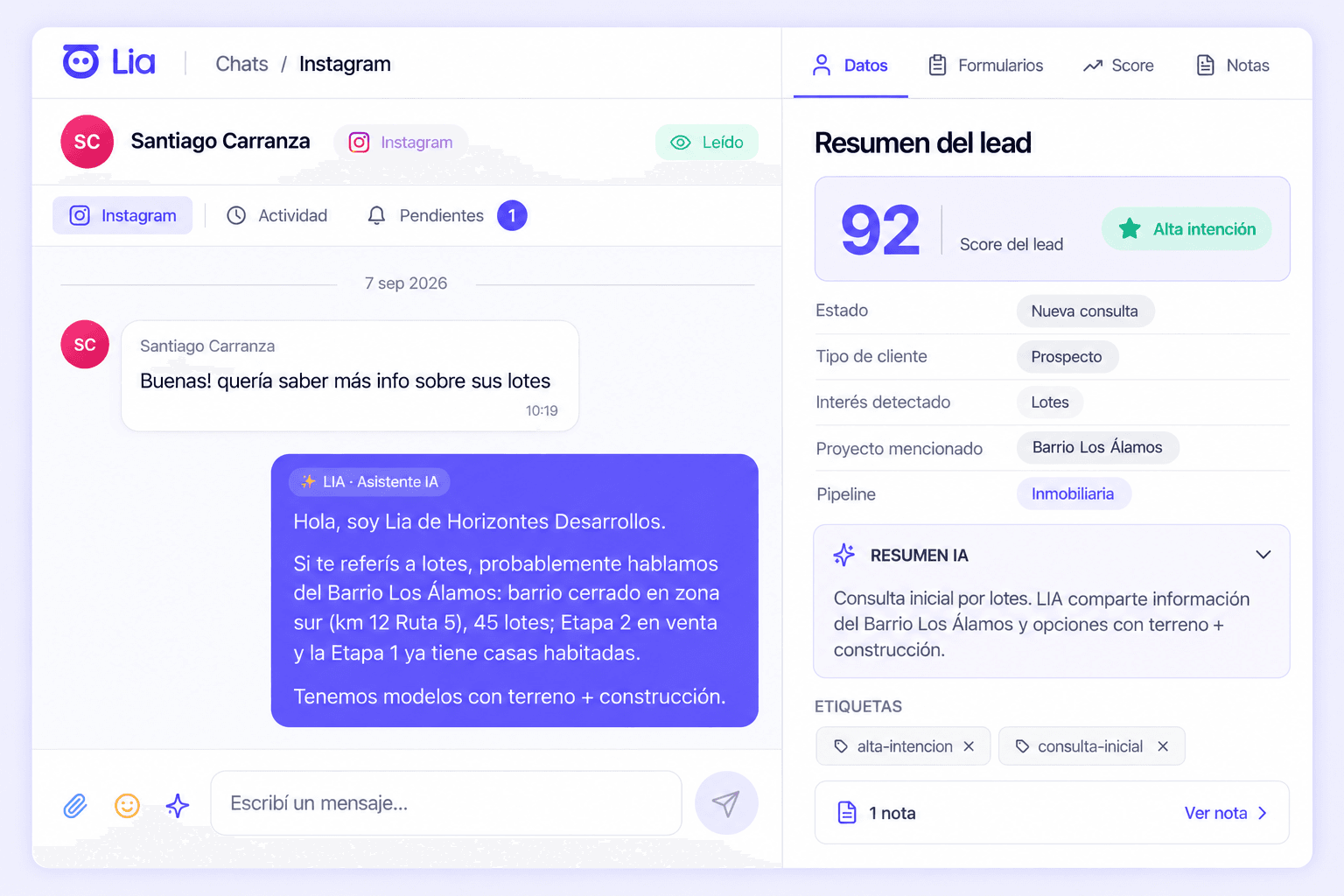
Everything you need to organise your sales operation
LIA brings together, in one platform, the tools needed to receive opportunities, distribute them among reps, follow up and analyse the team's results.
Omnichannel inboxAll your channels in one place
Brings together opportunities from WhatsApp, Instagram, Facebook, web and email so the team can work with an organised history.
- Web
A single inbox
Lead managementEvery opportunity with its information and context
LIA organises the lead's details, its source channel, its interactions, its sales status and the product or service it is interested in.
- Contact details
- Source channel
- Interactions
- Sales status
- Product of interest
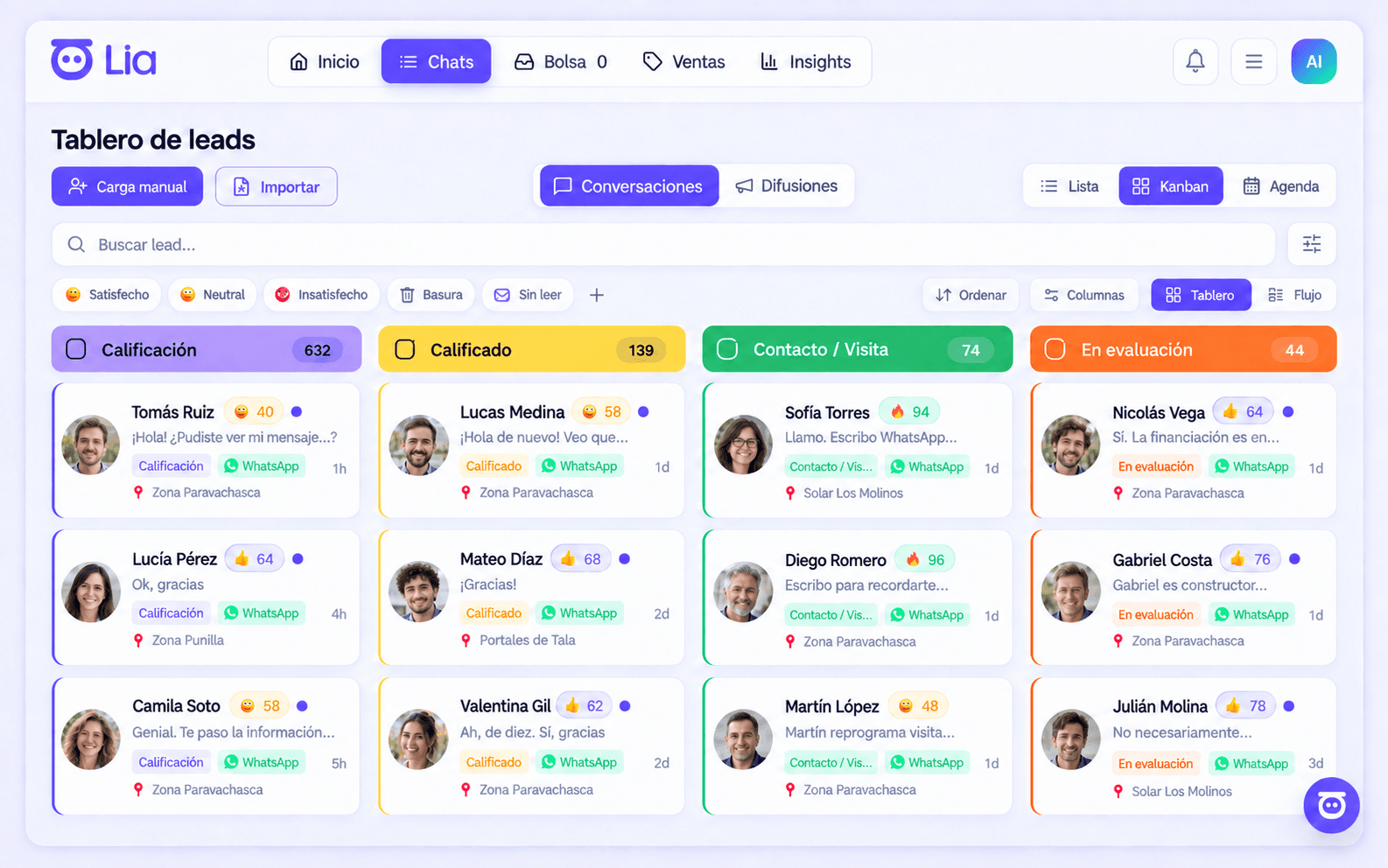
Prioritising and assignmentThe right lead for the right rep
LIA helps prioritise opportunities and distribute them among reps according to the sales rules the company has configured.
High priority
- Rep 1
- Rep 2
- Rep 3
Sales follow-upFewer forgotten opportunities
LIA can create tasks, notes, alerts and re-contact recommendations to reduce the risk of losing leads for lack of follow-up.
- Enquiry
- Reply
- Follow-up
- Re-contact
Assistant for repsEvery rep knows what to prioritise
LIA provides context, orders the opportunities and recommends next steps so the team can focus on the highest-impact actions.
- Priority leads
- Today's follow-ups
- Recommended re-contacts
- Pending tasks
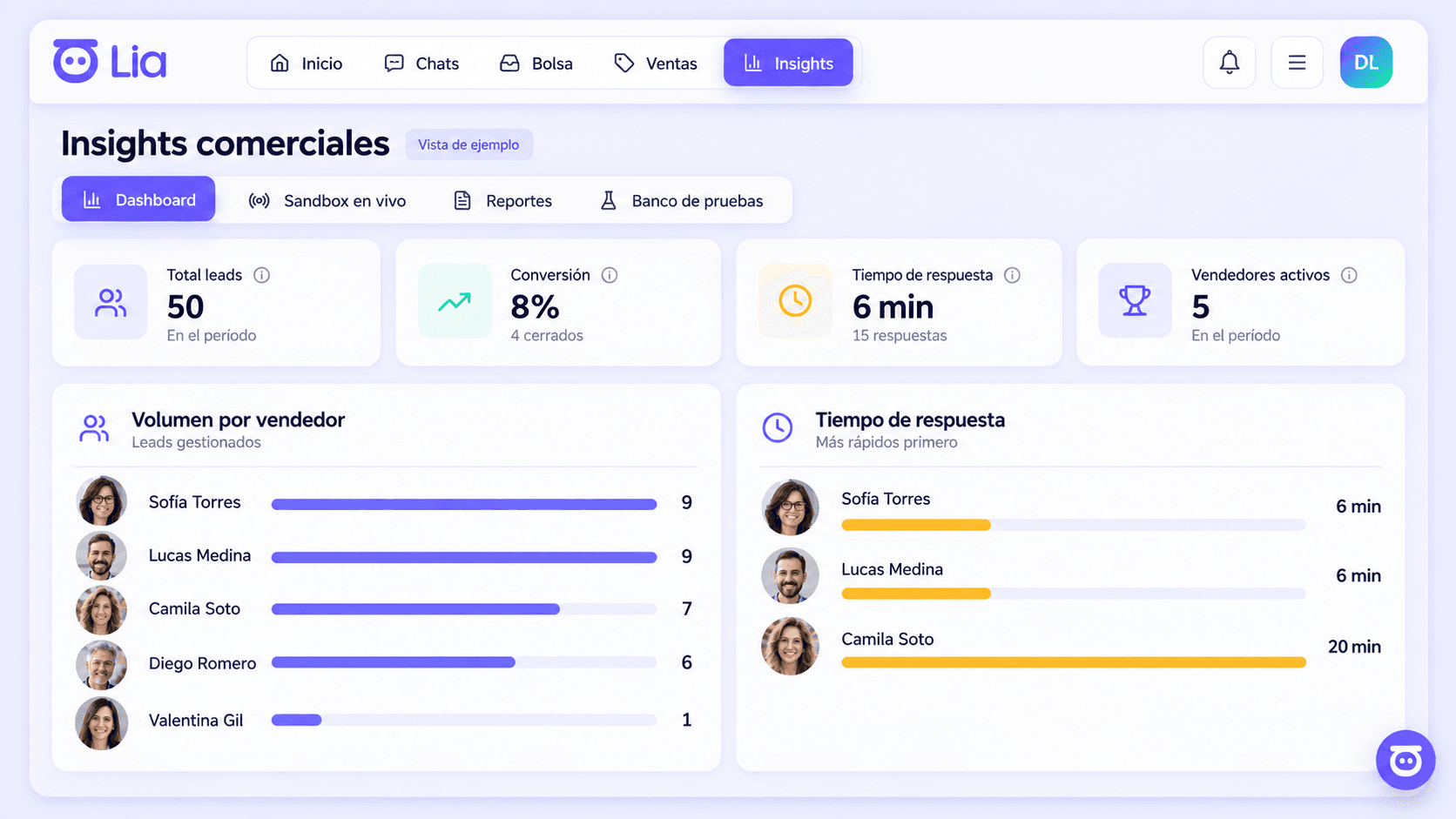
AI sales managerData turns into decisions
LIA analyses the team's performance, the channels, the campaigns and the opportunities to spot what matters and recommend actions.
- EjemploThere are high-priority opportunities with no follow-up.
- EjemploThis campaign brings many leads, but their sales quality is lower.
Deslizá para ver los demás módulos
In short
- LIA is an AI sales manager for running sales teams.
- A company that does not use a CRM yet can use LIA to bring together leads, reps, follow-ups and sales data.
- LIA does not just organise information: it analyses the operation and recommends actions.
- LIA brings together opportunities from WhatsApp, Instagram, Facebook, web and email.
Now that you know what AI can add, let's look at how to choose the right platform
Not every company needs the same features. Team size, channels, lead volume and the complexity of the sales process determine which solution makes sense.
What a good AI CRM should have
A CRM should not be chosen on feature count alone. The best platform is the one that fits the company's sales process, that the reps will actually use, and that helps turn information into actions.
Before comparing brands, assess these aspects.
Pick a criterion to see an example
A sales management platform has to let leads from WhatsApp, Instagram, Facebook, web and email be part of one single operation.
That keeps the history intact, identifies where each opportunity came from and stops the information ending up scattered across phones, inboxes and spreadsheets.
Question to assess itDoes the system really centralise the conversations, or does it only store contact details?
- Web
A single inbox
Storing a phone number or an email is not enough. The team needs to understand what the person is after and what happened before.
Every lead should carry information about:
- Name
- Company
- Source channel
- Product or service of interest
- Interactions
- Owner
- Sales status
- Next action
Question to assess itCan a rep quickly understand who the lead is, what they need and what to do next?
EjemploFicha de la oportunidad
- Name
- Incoming contact
- Source channel
- Interest
- Service enquired about
- Owner
- Rep 1
- Next action
- Re-contact scheduled
When a company has more than one rep, it needs to establish how opportunities get assigned and how it checks that each one is handled.
A CRM for several reps has to allow assigning owners, tracking follow-ups and measuring each team member's performance.
The platform must let you identify:
- Owner
- Status
- Response time
- Pending follow-ups
- Performance per user
Question to assess itDoes the system help distribute and supervise opportunities, or does it all rely on manual coordination?
One opportunity
- Rep 1
- Rep 2Asignado
- Rep 3
When many opportunities come in, they do not all carry the same intent, urgency or likelihood of moving forward.
An AI CRM can use sales information to help classify and prioritise leads through lead scoring, context or rules the company defines.
Question to assess itDoes the platform just show a list of contacts, or does it help the team decide where to spend its time?
EjemploTres oportunidades del mismo día
- HighAsked for pricing and left their details
- MediumEnquired about the service, no progress
- LowGeneral enquiry, no stated interest
Lack of follow-up is one of the main problems when the work depends on each rep's memory.
Assess whether the platform allows you to:
- Create tasks
- Schedule follow-ups
- Generate notes
- Send alerts
- Detect opportunities with no activity
- Recommend re-contacts
- Automate actions based on the lead's status
Question to assess itDoes the rep have to remember every follow-up, or does the system help keep the process alive?
- Enquiry
- Reply
- Follow-up
- Re-contact
Not every platform uses artificial intelligence the same way. Some offer text generation or summaries. Others can analyse the operation, spot what matters, prioritise opportunities and recommend actions.
Proactive sales intelligence should help answer questions like:
- Which opportunities need attention?
- Which rep has pending follow-ups?
- Where are leads being lost?
- Which segment converts better?
- Which campaign brings higher-quality opportunities?
Question to assess itDoes the AI perform isolated tasks, or does it help make sales decisions?
- EjemploThere are priority opportunities with no follow-up.
- EjemploThis segment shows better conversion.
- EjemploThis campaign brings volume, but lower sales quality.
Marketing should also be able to know what happens to leads after generating them, instead of depending only on how many forms or messages came in.
The platform should give visibility over:
- Leads by channel
- Leads by campaign
- Conversion
- Response times
- Performance by rep
- Follow-ups
- Process stages
- Quality of the opportunities
Question to assess itDoes the system only show activity, or does it let you connect it to sales results?
EjemploVolumen no es lo mismo que calidad
- Campaign AVolumenCalidadHigh volume, low conversion
- Campaign BVolumenCalidadFewer leads, better quality
A platform can have plenty of features and still fail if it is hard to roll out or if the reps do not take it up.
Before choosing, assess:
- Ease of use
- Mobile experience
- Training required
- Rollout time
- Integrations
- API
- Roles and permissions
- Room to grow
- Support
- Documented security
- Total cost
Question to assess itDoes the tool adapt to the company's process, or will the company have to rebuild its whole operation to use it?
Available features
Ease of adoption
Both weigh the same: a feature the team never uses is worth nothing.
The eight criteria, at a glance
| Criterion | Main question |
|---|---|
| Channels | Does it centralise every enquiry? |
| Leads | Does it keep information and context? |
| Team | Does it assign and measure reps? |
| Priority | Does it help decide what to handle first? |
| Follow-up | Does it cut down forgotten tasks? |
| AI | Does it analyse and recommend actions? |
| Metrics | Does it connect activity to results? |
| Adoption | Can the team actually use it? |
Checklist for choosing an AI CRM
Take these eight points into any platform comparison.
- It centralises my channels.
- It organises leads with context.
- It handles several reps.
- It helps prioritise opportunities.
- It automates follow-ups.
- It uses AI proactively.
- It measures sales and campaign quality.
- My company can adopt it and grow with it.
- To choose a CRM, a company should assess its channels, number of reps, lead volume, follow-up process, automation needs and integrations.
- A good CRM for sales teams has to centralise opportunities, keep the history, assign owners and let you measure results.
- An AI CRM should help prioritise leads, detect opportunities with no follow-up and recommend next steps.
- The platform with the most features is not always the best; ease of use, rollout and team adoption have to be assessed too.
Now let's compare every platform against the same criteria
For the comparison to be useful, each CRM has to be assessed on the same variables, using up-to-date information and stating its strengths, limitations and ideal cases.
Assessment methodology
How we compare AI CRMs and platforms
This comparison is built for companies that need to centralise leads, manage several reps, automate follow-up and analyse their sales operation. Every platform is assessed using the same criteria, the same scale and verifiable sources.
This comparison is published by LIA and includes our own platform. That is why the criteria, their weights, the sources and the limitations are shown publicly before presenting the ranking.
What kind of company is this guide for?
The methodology is aimed mainly at companies and SMBs in Argentina and Latin America that receive leads through digital channels, work with one or several reps and need to organise their sales follow-up.
- Sales teams
- Digital leads
- Several channels
- Need for follow-up and measurement
The result does not represent which is the best CRM for absolutely every company. It represents which one best fits the type of sales operation assessed in this guide.
The eight criteria and their weights
These are the criteria for choosing a CRM used throughout the comparison: the same eight from the previous section, in the same order. The weights were fixed before researching any platform and add up to 100.
Pick a criterion to see what is assessed
Qué se evalúa en este criterio
- Web
- Shared history
- Source identification
- Ability to centralise conversations and not just contacts
Qué se evalúa en este criterio
- Lead record
- History
- Sales status
- Owner
- Source
- Product or service of interest
- Next action
- Fields and context available to the rep
Qué se evalúa en este criterio
- Owner assignment
- Opportunity distribution
- Follow-ups per user
- Response times
- Performance by rep
- Visibility for management
- Working with several team members
Qué se evalúa en este criterio
- Lead scoring
- Priority criteria
- Sales context
- Intent detection
- Explanation of why it is a priority
- Ability to help the team decide what to handle first
Qué se evalúa en este criterio
- Tasks
- Notes
- Reminders
- Alerts
- Re-contacts
- Detecting opportunities with no activity
- Automation by stage or status
- Ability to cut down forgotten follow-ups
Qué se evalúa en este criterio
- Risk detection
- Recommendations
- Next actions
- Pattern analysis
- Proactive alerts
- Analysis of reps and opportunities
- Ability to turn data into decisions
Not enough to score high
- Writing emails
- Summarising text
- Having a chatbot
- Using the word "AI" in its marketing
The score has to reflect how much the artificial intelligence takes part in the sales operation.
Qué se evalúa en este criterio
- Leads by channel
- Leads by campaign
- Conversion
- Performance by rep
- Response times
- Follow-ups
- Pipeline stages
- Quality of the opportunities
- Link between source and sales result
Qué se evalúa en este criterio
- Ease of use
- Learning curve
- Mobile experience
- Rollout
- API
- Integrations
- Roles and permissions
- Scalability
- Documented security
- Support
- Pricing transparency
- Total cost where it can be verified
Sum of the weights100%
How each score is assigned
Knowing how to compare AI CRMs starts with using the same yardstick: each criterion is scored from 0 to 5 on the same scale for every platform.
- 0Not availableThe feature does not exist, or official documentation confirms it is not available.
- 1Very limitedThe capability exists in a minimal or manual form, or depends entirely on an external tool.
- 2BasicThe platform covers part of the need, but with significant limitations.
- 3CompleteThe feature properly covers the need of a typical sales team.
- 4AdvancedThe capability includes customisation, automation or above-average analysis.
- 5DifferentialThe feature is a core part of the product, works in an advanced way and offers clearly superior value for the case assessed.
N/VNot verified
There is not enough evidence to assign a reliable score.
- An unverified item does not automatically turn into a zero.
- No final position is calculated until there is enough evidence across the eight criteria.
How we calculate the final result
Each criterion's score is divided by five and multiplied by its weight. The eight results are then added up for a total score out of 100.
Generic example
- Criterion score
- 4 out of 5
- Criterion weight
- 15%
4 ÷ 5 × 15 = 12 points
The weights are set before researching and scoring the products. No platform starts with a score assigned.
What sources we use
Primary source
- Official documentation
- Official product page
- Official pricing page
- Integration documentation
- Official AI documentation
- Security documentation
Supporting source
- Independent analysis
- Product testing
- Editorial comparisons with a methodology
- Consistent opinions from verifiable users
Not sufficient on its own
- Promotional text with no documentation
- Affiliate rankings with no methodology
- Isolated opinions
- Search engine snippets
- Generated content with no sources
Features, integrations and prices have to be backed mainly by official sources. Independent sources are used to assess adoption, user experience and limitations.
How we validate each capability
Before scoring a feature you have to tell what kind it is:
- Native
- Available through an integration
- Available only on certain plans
- Requires custom configuration
- In beta
- Announced, but not available yet
- Depends on a partner
- Not verified
- A native feature is not scored the same way as one available only through an external integration.
- A feature that requires a higher plan or an extra payment is not presented as included.
Date and confidence level
Each platform assessed carries its own verification record with these fields:
Sample record
- Last review
- Pending
- Sources consulted
- Pending
- Status
- Not assessed
- Confidence level
- Pending
- High confidenceMost features, integrations and prices are backed by up-to-date official documentation.
- Medium confidenceThe main information was verified, but some details are still pending.
- Low confidenceSeveral capabilities lack sufficient documentation.
A platform with low confidence does not hold a definitive position without an additional review.
LIA is assessed by these criteria too
LIA is part of the comparison and is analysed on the same scale as every other platform. Its features have to be backed by validated internal documentation, real demonstrations or verifiable public information.
If a LIA capability is not yet confirmed or documented, it has to be marked as pending and not presented as a universal feature.
Data we always report
Even when they are not the main reason for a position, these details appear in every platform's record:
- Price
- Currency
- Charged per user or per account
- Additional costs
- Language
- Regional support
- Availability in Argentina and Latin America
- Security
- Roles and permissions
- Rollout difficulty
- Limitations
- Who it is not recommended for
- To compare AI CRMs you have to use the same criteria, the same scale and verifiable sources.
- The best platform depends on the type of company, its channels, the number of reps and the features it needs.
- A native feature should not be assessed the same way as one available only through an external integration.
- This comparison is published by LIA and includes its own platform, which is why the methodology and the sources are shown transparently.
A useful comparison needs clear criteria
With this methodology, each platform can be compared on its ability to centralise opportunities, manage reps, automate follow-up, use artificial intelligence and provide information for decision-making.
